During spring and early summer, the melodic song of the black-headed grosbeak is a familiar sound in the oak woodlands of the Santa Cruz Mountains. Often heard before they are seen, black-headed grosbeaks arrive each spring from their wintering grounds in Mexico and Central America to breed throughout California’s woodlands and riparian habitats.
The grosbeak’s rich, warbling song is often compared to that of an American robin, but is generally considered more fluid, varied, and musical. Unlike many songbirds where only males regularly sing, both male and female black-headed grosbeaks are known for their vocal abilities.
Where to find black-headed grosbeaks
In the Santa Cruz Mountains, black-headed grosbeaks are most commonly found in oak woodlands, mixed hardwood forests, and riparian corridors. They favor areas where deciduous trees such as black oaks and bigleaf maples are abundant, often occurring along woodland edges and stream corridors. While they can be found in mixed forests, they are generally less common in dense redwood stands.
Black-headed grosbeaks are often easiest to find where open meadows meet woodland. Along Sunnyvale Mountain Trail where the meadow transitions into black oak woodland, black-headed grosbeaks can often be seen and heard during the breeding season. Another reliable place to encounter them is near the large mature eucalyptus tree by the upper lake area of Bear Creek Redwoods Open Space Preserve. Farther along Skyline Trail, grosbeaks remain common, but are often harder to see as the trail enters denser mixed conifer forest.
In the eastern foothills of Santa Clara County, black-headed grosbeaks can often be found along the eastern portion of the Sierra Vista Trail in Sierra Vista Open Space Preserve, where the trail winds through oak grasslands.
Identification
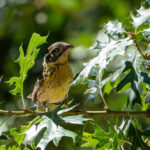
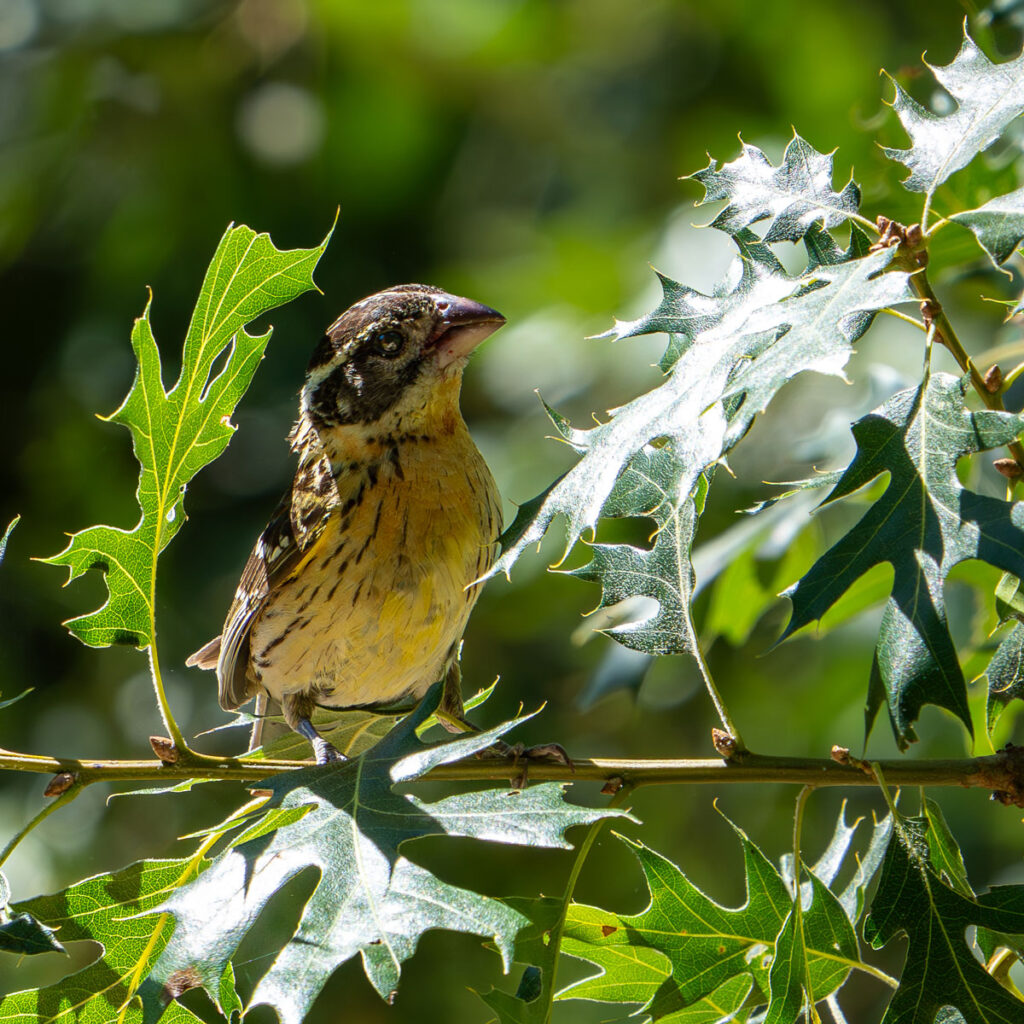
Male black-headed grosbeaks are striking birds with black heads, warm cinnamon-colored underparts, and bold white wing patches. Females are more subtly colored, with streaked brown plumage that provides excellent camouflage while nesting. Both sexes share the species’ large, conical bill, which is well adapted for cracking seeds and consuming a wide variety of foods.
Diet and feeding behavior
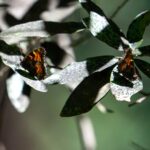
During the breeding season, black-headed grosbeaks feed primarily on insects and spiders. Caterpillars, beetles, and other invertebrates provide an important food source for both adults and their growing nestlings. As summer progresses, their diet expands to include berries, fruits, buds, and seeds. Black-headed grosbeaks are also one of the few birds capable of eating monarch butterflies despite the toxins that deter many other predators.
Breeding and nesting
Breeding season typically extends from late April through August. Nests are built in shrubs or trees, often near streams or other water sources. Both males and females participate in incubating the eggs and caring for the young. Female black-headed grosbeaks sing during many stages of nesting, including while incubating eggs and caring for young. In some cases, females have even been observed singing songs that closely resemble those of males.
References
Bent, A. C. (1968). Life histories of North American cardinals, grosbeaks, buntings, towhees, finches, sparrows, and allies. U.S. National Museum Bulletin 237.
California Department of Fish and Wildlife. Black-headed Grosbeak (Pheucticus melanocephalus). California Wildlife Habitat Relationships System.
Cornell Lab of Ornithology. All About Birds: Black-headed Grosbeak.
Ritchison, G. (1983). The function of singing in female black-headed grosbeaks (Pheucticus melanocephalus): Family-group maintenance. The Auk, 100(1), 105–116.
Ritchison, G. (1983). Possible “deceptive” use of song by female black-headed grosbeaks. Condor, 85(2), 250–251.
More Santa Cruz Mountains Birding