Harriers are a type of low-flying hawks that can be found over open areas like grasslands and marshes. With a face that can appear more like an owl, harriers are daytime hunters who use both sight and sound to find their prey.
Only harrier in the United States
Worldwide, there are 13 species of harriers. Only one, the northern harrier, is found in the United States.
Low-flying raptors
Northern harriers get their owl-like features from the disk shape of their face which helps to funnel sound towards their ears. These harriers use both sight and sounds as they look for small movements in the grass and marshes signaling the presence of small prey.
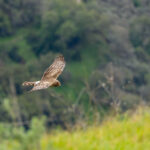
Northern harriers are know for their low, methodical flying over vegetation. These raptors, especially during the winter, spend long periods actively hunting over marshes and fields.
Identifying northern harriers
Northern harrier fly in slow circling movements over open fields and marshes. In flight, their v-shape wing formation, long tail, and white rump are the easiest markers for identifying these hawks.

Dimorphic harriers
Male and female Northern Harriers are easy to tell apart. Northern Harriers show sexual dimorphism, meaning the two sexes look different.

Adult males are pale gray with black wingtips and a light underside, a combination that gives them a soft, floating look as they hunt low over fields and marshes. Birders often call these males the “gray ghost,” a nickname that fits their quiet, drifting flight.
Females are larger and noticeably browner, with streaked underparts and darker wings that help them blend into grasslands and wetlands, especially during nesting season. Both sexes show a bright white rump patch that flashes into view as the bird turns, one of the most reliable field marks of the species.
Where to see Northern Harriers in the Silicon Valley Area
Northern harriers are most commonly found in areas with a significant amount of open fields or marshlands.
Alviso Marina County Park is a reliable place to see Northern Harriers, with these birds often flying over salt ponds, levees, and adjacent marsh. The mix of shallow water, pickleweed, and grassy edges supports rodents and small birds, which make up much of their diet. Fall through spring is the most consistent time to visit, when harriers spend long stretches actively hunting during daylight hours.

Coyote Hills Regional Park, near the Don Edwards San Francisco Bay National Wildlife Refuge, has a combination of grassy hills with wetlands and seasonal ponds, and harriers often move between these habitats while hunting.

Farther inland, grassland-dominated open space preserves are key. On the East Bay and Diablo Range side, Sierra Vista Open Space Preserve offers rolling, treeless hills that are well suited to harriers.
In the Santa Cruz Mountains, harriers are present where grasslands open up. Russian Ridge Open Space Preserve provides extensive high-elevation grasslands where harriers are frequently spotted gliding along slopes and ridgelines.
The importance of preserving grassland and marshland for these raptors
Northern Harriers are one of the best reminders of how important a diversity of open space is in Silicon Valley. Their slow, low hunting flights are easiest to see in wide grasslands and wetlands. Preserving a diversity of open space, not just redwood forests, is important for species that rely on open habitat for survival.