Turkey vultures (Cathartes aura) are a familiar sight throughout the Santa Cruz Mountains and the Silicon Valley region. The vultures’ slow, steady circles in the sky, broad wings held in a shallow V, and slight wobbling as they ride rising air currents make them easy to spot on a hike. Read on to understand what these vultures are doing when you see them circling, soaring, or gathering on the ground.
Using rising air to stay aloft
Turkey vultures rely heavily on warm rising air called thermals. As sunlight heats the ground, pockets of warm air rise, forming columns that vultures can ride upward with very little wing movement. When several vultures spiral upward in the same thermal, the behavior is called kettling. These kettles can include a few individuals or dozens, depending on weather and season. The wobbling flight often seen during this behavior reflects how they finely adjust their wings to stay balanced in shifting air.

Along ridgelines they also use ridge lift created when wind hits slopes and is pushed upward. Both forms of rising air allow turkey vultures to travel considerable distances without expending much energy.
Telling the difference between vultures and hawks in the sky
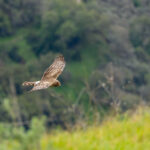
Turkey vultures hold their wings in a shallow V while soaring and show a gentle rocking motion as they ride shifting air currents. They usually glide with very little flapping. Hawks, by contrast, hold their wings level and rely on stronger, more regular wingbeats. They appear more compact, with broader bodies and shorter tails. The long, two toned wings and small head of a turkey vulture usually make identification straightforward.
The exception of the zone tailed hawk
One rare exception is the zone tailed hawk, a species that closely mimics the flight style of turkey vultures. It soars with a similar rocking motion and often blends into kettles of vultures, which may allow it to approach prey without being noticed. Zone tailed hawks are considered uncommon visitors in the Santa Cruz Mountains and Silicon Valley, with sightings occurring only occasionally during migration. This mimicry adds a subtle challenge to identifying raptors in flight.
Warming up before flight
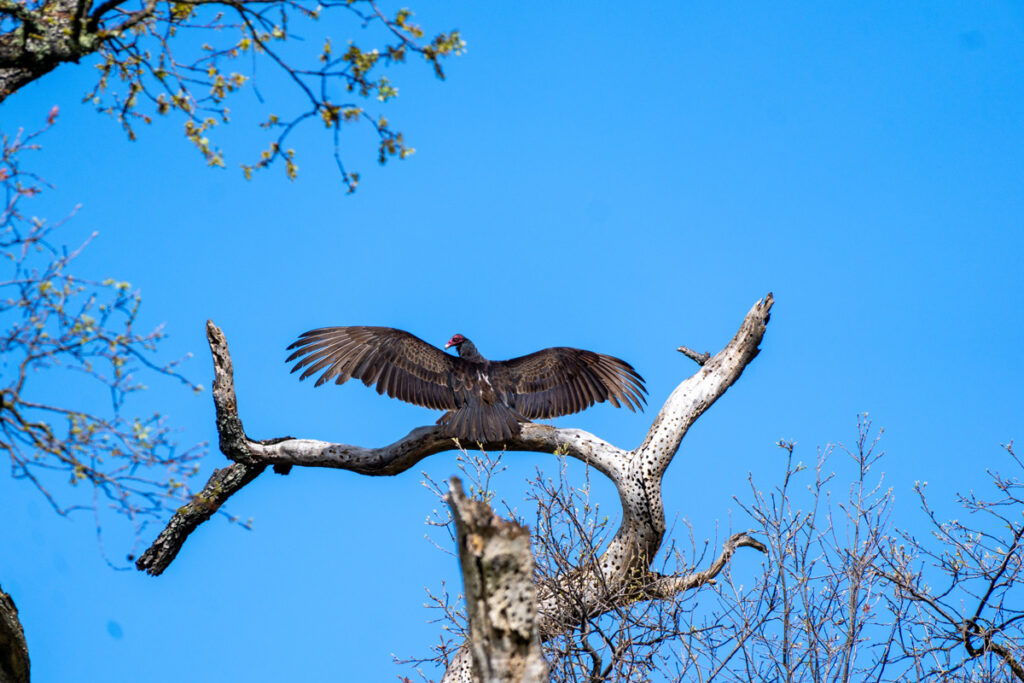
On cool mornings, turkey vultures are often seen standing with their wings fully spread. This characteristic posture is known as the horaltic pose. It helps them absorb sunlight to warm their bodies, dry their feathers, and reduce bacterial load on their plumage.

Since thermals form once the ground warms, vultures often begin flying later in the morning. Early hikers may pass quiet roosts along open slopes, power poles, or tall trees.
Feeding behavior of turkey vultures
Turkey vultures (Cathartes aura) are obligate scavengers, meaning they feed only on dead animals. Their reliance on carrion shapes every part of their feeding behavior, from how they search for food to how they digest it.
What is carrion?
Carrion is the body of an animal that has already died and begun to decompose. Because carrion contains bacteria and other pathogens, turkey vultures depend on specialized physiological traits to find it and consume it safely and efficiently.
How turkey vultures find food
Turkey vultures use both vision and smell to locate carcasses. They can spot large carcasses from several miles away and detect faint gases released during early decomposition, including ethyl mercaptan. This dual sensory ability allows them to find food even when vegetation or terrain hides it from view.

Their slow circling flight helps them scan broad areas efficiently. When they circle repeatedly over one location, they may be tracking a scent or evaluating whether it is safe to descend to a carcass.
Digestive adaptations for eating carrion
Turkey vultures tolerate decomposing flesh because their digestive system neutralizes dangerous microbes. Their stomach acid has a pH close to 0, strong enough to kill many bacteria and viruses that would make other animals ill. This protects the birds and reduces pathogens in the environment, making vultures important agents of natural disease control.
Group feeding and social behavior
When multiple vultures gather at a carcass, the group is called a wake.
Large carcasses may draw more vultures, leading to several individuals perched nearby while they wait for access. From a distance, these gatherings may appear loosely scattered, but the structure reflects a balance of caution, social tolerance, and feeding opportunity. Turkey vultures may jostle with each other to get first dibs at the carcass.

Other scavengers at a carcass
Carcasses often draw multiple scavenger species, including crows and ravens. These birds feed alongside turkey vultures and may compete for access, especially at smaller carcasses. Ravens in particular can be assertive and may challenge vultures during feeding.
Turkey Vultures Gather in Committees
A group of vultures gathered together is called a committee, and these groups can form on the ground or on elevated perches such as tree branches, fence lines, or utility poles. Committees may appear loosely spaced, but the birds function as a calm social unit while resting, warming up, or evaluating conditions in the area.

Next time you’re hiking, scan the skies for these soaring birds and watch how they ride the air.