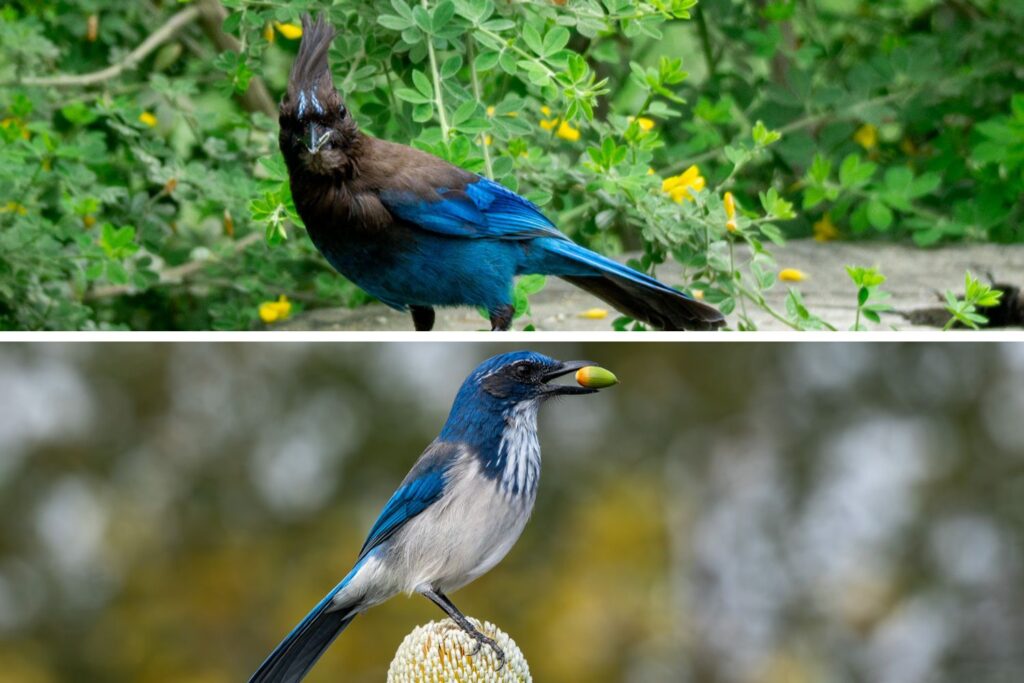
Two striking blue jays are commonly seen on trails throughout the Silicon Valley area: the California scrub jay and the Steller’s jay. Although they share similar colors, they differ in appearance, habitat, behavior, and calls. Once you know what to look for, it’s surprisingly easy to identify which species you’ve encountered on the trail.
What are jays?
Jays are intelligent birds in the crow family (Corvidae), which also includes crows, ravens, and magpies. Like their corvid relatives, jays are highly adaptable and known for their problem-solving abilities, complex social behavior, and varied vocalizations. The California scrub jay and the Steller’s jay are the two jay species most commonly encountered by hikers in the Silicon Valley area.
Physical differences between the scrub jay and Steller’s jay
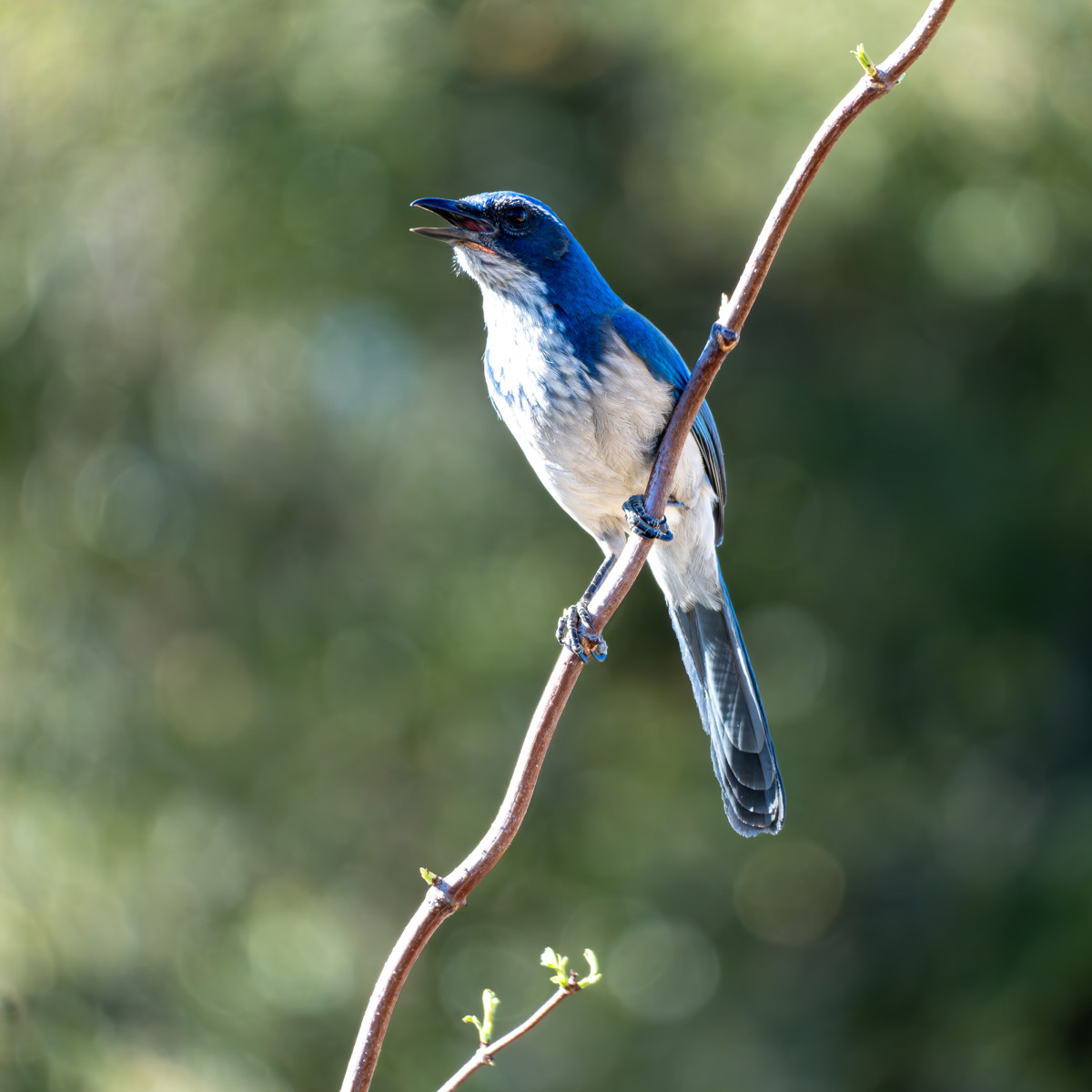
The California scrub jay (Aphelocoma californica) is a medium-sized bird with blue plumage on its wings, tail, and head. Scrub jays have a lighter coloration on the underparts—often a soft gray to whitish belly—with blue and gray markings across the back and shoulders. Black patches of feathers run from the eyes down the cheek.

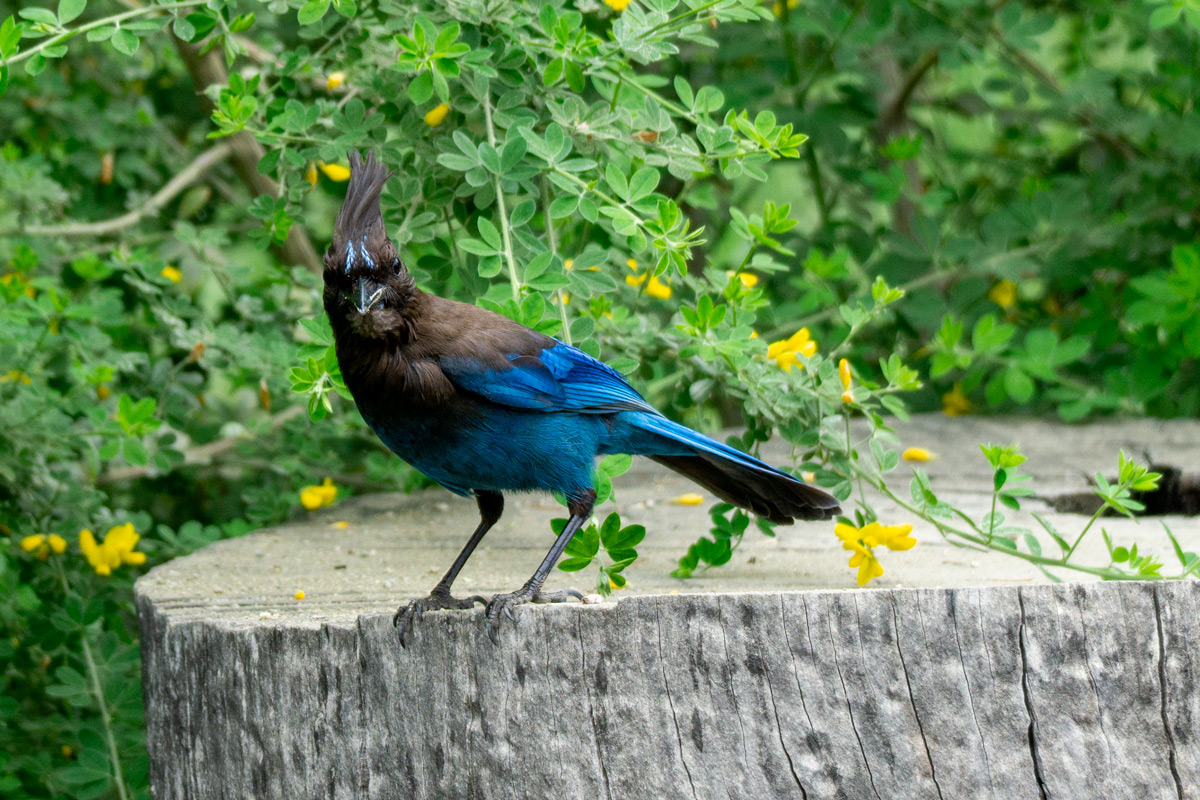
The Steller’s jay (Cyanocitta stelleri) is identifiable by its prominent crest, which it frequently raises or lowers depending on mood or environmental conditions. The Steller’s jay has dark blue feathers covering its lower body. The upper body from the tips of the wings to the crest is black or deep charcoal gray with two light blue stripes on the forehead.
Habitat preferences
While both jays can overlap in the foothill regions of Silicon Valley, their preferred habitats usually differ:
California scrub jay habitat
The scrub jay primarily inhabits oak woodlands, suburban gardens, brushy chaparral, and areas with scattered trees or shrubs. Scrub jays are comfortable in open areas, frequently seen in parks, residential neighborhoods, and along urban trails.

Steller’s jay habitat
A shyer bird than the scrub jay, the Steller’s jay prefers denser, coniferous forests or wooded foothills, typically at higher elevations. Within Silicon Valley, hikers commonly observe Steller’s jays in shaded forests such as Big Basin, Sanborn County Park, Rancho San Antonio Preserve, and other redwood and mixed evergreen habitats. In my experience, seeing a Steller’s jay is often one of the first signs that I’ve left the chaparral behind and entered denser forest.

When hiking in the Santa Cruz Mountains, I almost always expect to see Steller’s jays once I enter dense mixed evergreen or redwood forest. On trails dominated by oak woodland and chaparral, California scrub jays are usually the more common species. In the transition between these habitats, it’s not unusual to encounter both species on the same hike.
Behavior
California scrub jays are notably curious, often boldly approaching human visitors, particularly in areas where people frequently offer food. They forage primarily for insects, acorns, seeds, and berries. Notably, scrub jays frequently cache—or hide—acorns, contributing significantly to oak regeneration within their habitats. They are socially interactive but usually appear singly or in pairs rather than large groups.
Steller’s jays exhibit a somewhat bolder, more territorial behavior compared to scrub jays. Known for their assertive personalities, these birds often vocalize loudly when disturbed or defending territory. Their diet is similarly diverse, feeding on nuts, berries, insects, and occasionally small animals or eggs from other bird species.
Calls
Scrub jay: Calls are typically loud and harsh, but also melodious and varied. Scrub jays frequently produce a sharp “shreep” or “squawk,” often repeated as part of a communication pattern between individuals.
Steller’s jay: Vocalizations tend toward louder, harsher, and more repetitive notes, often described as a loud “shack-shack-shack” or “jee-ah.” Their calls are generally more aggressive-sounding, especially when alarmed or defending their territory.
Scrub Jay vs. Steller’s Jay: Key Differences
| Feature | California scrub jay | Steller’s jay |
|---|---|---|
| Crest | None | Prominent crest |
| Head | Blue | Black/charcoal |
| Habitat | Oak woodland, chaparral, neighborhoods | Mixed evergreen & redwood forests |
| Elevation | Lower | Higher |
| Personality | Curious | Bolder, more territorial |
| Common call | “Shreep” | “Shack-shack-shack” |
Trail tip
If you suddenly notice Steller’s jays replacing scrub jays on your hike, you’ve probably transitioned from open oak woodland into denser mixed evergreen or redwood forest.
This article was originally written on March 19, 2025 and has since been updated.